
Most beginners can recognize the basic letters within a few weeks of regular practice. However, reading them confidently by sound requires continued listening and repetition.
The International Morse Code alphabet represents all 26 English letters from A to Z. It also includes separate patterns for numbers, punctuation marks, and procedural signals.
E . and T – are usually the easiest letters because each contains only one signal. E is one dot, while T is one dash.
There is no single hardest letter for everyone. However, four-signal characters such as J .—, Q –.-, Y -.–, and Z –.. may require more practice because their patterns are longer and easier to confuse.
You may memorize many characters in one week, especially with daily practice. However, recognizing Morse code letters immediately by sound usually takes longer than remembering them from a chart.
Use the chart to understand each pattern, but train mainly by ear. Hearing complete “dit” and “dah” rhythms helps you recognize letters faster than counting dots and dashes visually.
You do not need to learn the letters alphabetically. Start with two distinct characters, practice them until they feel familiar, and then introduce one new letter at a time.
No. Morse represents letters through dots and dashes, while the NATO phonetic alphabet uses words such as Alpha, Bravo, and Charlie. Both systems clarify letters, but they use completely different methods.
Practice for 10 to 15 minutes each day, listen to character sounds, and begin with short words or your name. You can also study reverse pairs such as A .- and N -. to recognize related patterns more quickly.
Find quick answers to common questions about learning and using the Morse code alphabet.

Each English letter has its own signal pattern. For example, A is .-, B is -…, and C is -.-.. Therefore, you can use the chart to find and write every letter in Morse code.

Letters are separated by short spaces, while a longer space separates complete words. This spacing helps you identify where one character ends and the next begins.

The alphabet chart allows you to compare an unknown sequence with its matching letter. However, regular practice will gradually help you recognize each pattern without checking the chart.

You can listen to letters as combinations of “dits” and “dahs.” Connecting each character with its rhythm makes the Morse code A to Z easier to remember.

Beginners can start by converting their name, initials, or familiar words. This creates short exercises that are more memorable than random character groups.

After writing a word in Morse, compare each character with our Morse code letter chart. This simple check helps you find reversed patterns, missing signals, and incorrect spaces.
The Morse code alphabet helps you convert individual letters into recognizable patterns of dots and dashes. Once you understand these patterns, you can combine them to read, write, and practice complete words.
Look at E . and T – in our chart. Each letter contains only one signal, making them the shortest characters in the entire system. In contrast, letters such as J .—, Q –.-, and Z –.. require four signals.
This pattern reflects one of Morse code’s most useful features. Common English letters often have shorter combinations, while many less frequently used letters have longer ones. As a result, everyday words can be transmitted more efficiently.
However, memorizing all 26 characters in alphabetical order is rarely the best way to learn the Morse code alphabet. Morse is based on sound and rhythm, so your practice should train your ears instead of turning every signal into a visual lookup exercise.
Start with the Koch Method
The Koch Method introduces only a few characters at a time while playing them at a realistic character speed.
Because characters are played at full speed from the beginning, you learn their natural rhythm without counting individual dots and dashes.
Learn Reverse Pattern Together
Several Morse code letters use opposite signal patterns. Studying these pairs together makes their differences easier to recognize:
Listen for the position of the dash. For example, B begins with a dash, while V ends with one.
Train Your Ear Before your Eyes
When you hear .-, avoid thinking, “dot-dash equals A.” Instead, learn the complete sound as “dit-DAH.” With regular listening practice, the character will begin to feel like a familiar spoken sound.
You can reinforce each rhythm by:
Mnemonic phrases can help you remember difficult patterns at first. However, use them only as temporary memory aids because direct sound recognition is faster during real communication.
Use Frequency and Structure as Shortcuts
Start with frequently used characters such as E, T, A, O, I, and N. Once you recognize these letters, you may begin identifying parts of common English words.
In addition, use a Morse code tree to understand how the alphabet is structured. A dot follows one branch, while a dash follows the other. The tree is useful for reviewing patterns, but listening practice should remain your main learning method.
Common Decoding Mistakes (and How to Avoid Them)
Some characters sound similar, especially when signals are sent quickly:
When people search “Morse code alphabet” they almost always mean International Morse the version on this page. But there’s an older one worth knowing about.
Correct Morse code timing makes dots, dashes, letters, and words easy to separate. The basic unit is one dot:
Speed is measured in words per minute, commonly using “PARIS” as a 50-unit reference word. For beginners, Farnsworth timing keeps characters clear while adding longer gaps between them.
After learning letters and numbers, the next step is understanding Morse code punctuation. These patterns let you add pauses, questions, addresses, and other details to a complete message. However, not every modern keyboard symbol has a standard Morse sequence.
Our chart includes commonly recognized marks such as the period, comma, question mark, apostrophe, slash, colon, hyphen, and at sign. For exampl, a period is .-.-.-, a question mark is ..–.., and an at sign is .–.-.. Therefore, the Morse code alphabet and punctuation can work together to create clearer written messages.
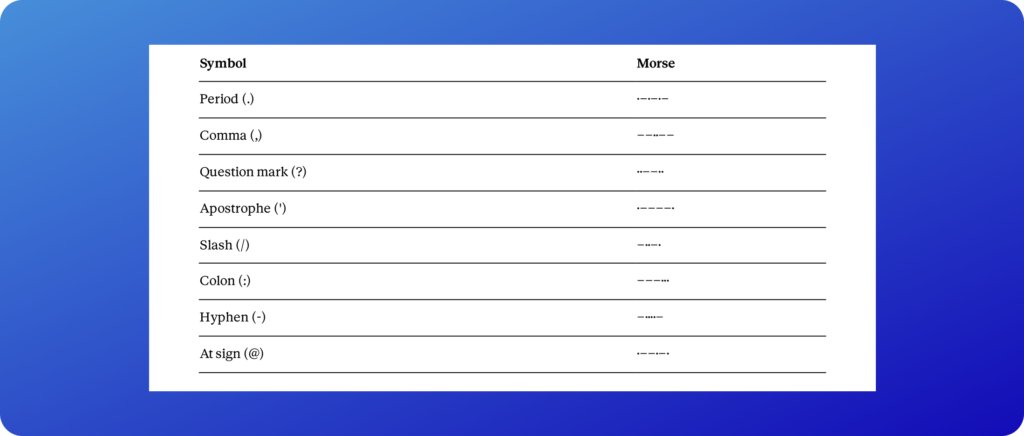
Start by learning the punctuation marks you use most often. Next, practice them inside short sentences instead of memorizing each sequence alone. This makes their position and purpose easier to remember.
Common Morse Code Prosigns
In addition to punctuation, operators use prosigns to communicate instructions. A prosign joins several signals into one continuous pattern, so it should be sent without spaces between its parts.
Because prosigns carry procedural meanings rather than ordinary letters, keep them separate from normal words when studying Morse code symbols.
All numbers in Morse code contain exactly five signals. The sequence begins with 1 .—- and replaces one dash with a dot at each step until it reaches 5 …... After that, the pattern reverses direction and replaces one dot with a dash at each step until it reaches 0 —–.
For example, 2 is ..—, 6 is -…., and 9 is —-.. Because these patterns follow a consistent order, you can learn the complete number set as one sequence instead of memorizing ten unrelated combinations.
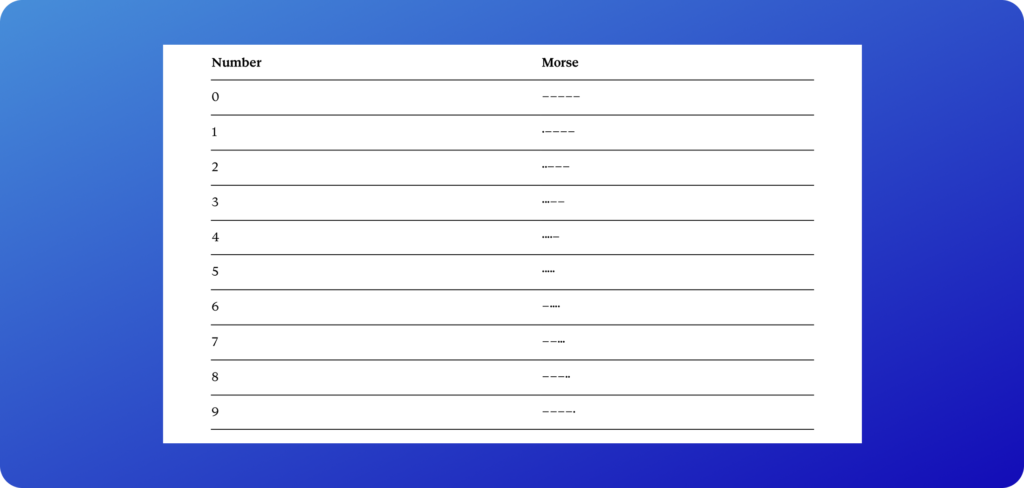
First, practice the numbers in order. Next, test them in dates, times, phone numbers, and short messages. In this way, the Morse code alphabet and numbers work together as one complete character system.
Our Morse code alphabet chart lists every English letter from A to Z with its correct dot-and-dash sequence. Each row also shows the spoken “dit” and “dah” rhythm, helping you connect the written pattern with its sound.
Start with simple characters such as E . and T -. Next, compare opposite patterns such as A .- and N -.. This step-by-step approach makes Morse code A to Z easier to understand than trying to memorize every character at once.
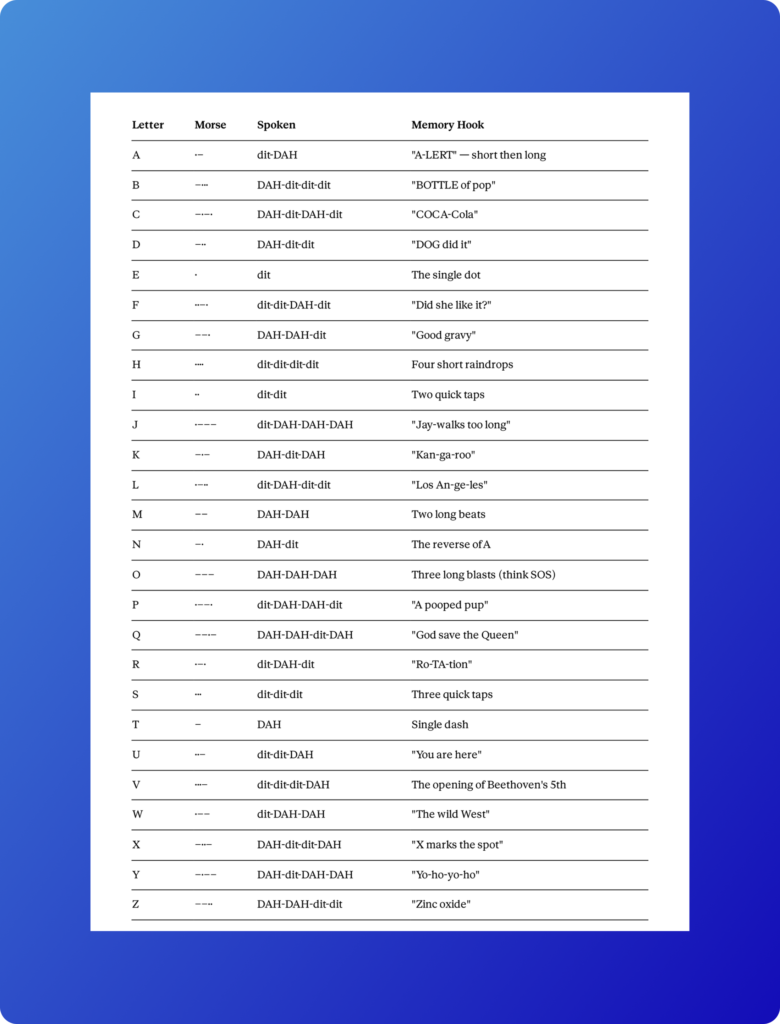
Quick Tip: When practicing every letter in Morse code, say the complete rhythm aloud instead of counting separate symbols. For example, read A as “dit-dah,” not “dot-dash.” Then, listen to the same character in audio form so its full pattern becomes easier to recognize.
Once the letters feel familiar, you can move to digits. Fortunately, number patterns follow a clear order, which makes them easier to study.
The Morse code alphabet is a signaling system that represents each supported letter and number through a unique sequence of dots and dashes. A dot is a short signal, while a dash lasts longer. In addition, carefully timed spaces separate parts of a character, complete letters, and words.
With our chart, you can view the complete alphabet in Morse code from A to Z. We use the International Morse Code alphabet, which follows the standard patterns recognized worldwide. Because the same patterns can be expressed through sound, light, radio tones, or tapping, you can study them in several different formats.
However, correct timing and spacing are just as important as the dots and dashes. Therefore, our guide shows both the written pattern and its spoken “dit” and “dah” rhythm.

With our Morse code alphabet chart, you can explore every letter from A to Z in one clear place. Each character has its own pattern of short dots and long dashes. Therefore, we have arranged the complete alphabet in a simple format that beginners can read, hear, and practice easily.
We created this guide to help you understand Morse code letters, correct signal timing, and common character patterns. In addition, you can use our audio examples and learning tips to study the International Morse Code alphabet step by step without feeling overwhelmed.