
Once you can hear the difference between five short beeps and five long ones withoutthinking, the rest of the number system slots in fast. Drill the two rules, train your ear on real audio, and you’ll be reading digits in Morse within a week.
Yes. International Morse Code includes separate patterns for all ten digits from 0 to 9. Each digit contains exactly five dots, dashes, or a combination of both.
The basic Morse code numbers 0–9 are: 0 —–, 1 .—-, 2 ..—, 3 …–, 4 ….-, 5 ….., 6 -…., 7 –…, 8 —.., and 9 —-.
Digits 1 through 5 begin with dots and end with dashes. Digits 6 through 9 begin with dashes and end with dots, while 0 contains five dashes.
Convert each digit separately and keep the patterns in their original order. For example, 27 is written as ..— –….
Separate digits have a 3-unit character gap, just like separate letters within a word. In written examples, this gap is normally shown with a single space between the digit patterns.
No. Values above 9 are formed by combining the patterns for individual digits. For example, 10 is .—- —–, while 100 is .—- —– —–.
Treat a short flash as a dot and a long flash as a dash. Next, use the pauses to separate signals, complete digits, and different groups.
English letters contain between one and four signals, while every standard digit contains five. However, both use the same dot, dash, timing, and spacing rules.
Cut numbers are shortened digit forms used in some fast CW and amateur radio exchanges. For example, 9 may be sent as N -., but the full pattern —-. remains the standard form.
Learn the two pattern groups first, then practise the complementary pairs 1 and 6, 2 and 7, 3 and 8, 4 and 9, and 5 and 0. Finally, use short daily listening exercises with dates, times, and familiar numbers.
Yes. Punctuation can be added as a separate character when writing decimals, dates, times, or ranges. For example, the decimal point is .-.-.-, while the colon is —….
Find clear answers to common questions about reading, writing, and learning Morse code numbers.

VOR, NDB, and TACAN beacons broadcast a Morse identifier — usually three letters, sometimes including digits — that pilots verify on the audio panel before trusting the navigation signal. Every active beacon transmits this ID continuously

While the Global Maritime Distress and Safety System has replaced most manual Morse traffic, naval signal lamps during radio silence still flash numbers as part of position reports and ship identification.

Ham operators making contacts on CW exchange RST reports — Readability, Strength, Tone — as three digits like 599 (or 5NN in cut form). It’s the single most common piece of numeric Morse on the air

People using single-switch or two-switch input systems for ALS or locked in syndrome can enter both letters and numbers via Morse. Google’s Gboard added Morse code input in 2018 specifically for this use case

While the Global Maritime Distress and Safety System has replaced most manual Morse traffic, naval signal lamps during radio silence still flash numbers as part of position reports and ship identification.

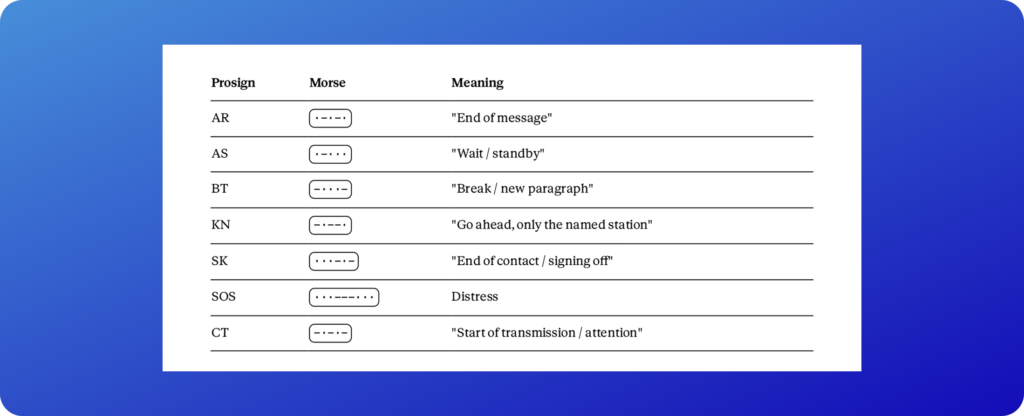
The classic SOS ( ···−−−··· ) is a prosign, not a number, but real distress messages often include numeric coordinates, time stamps, or survivor counts sent in standard Morse digits
Morse words aren’t a relic. They’re quietly active across several fields:
The advice you’ll see most often — flashcards, mnemonics, write them out — works, butit’s slow. The faster path uses the same approach competitive Morse operators use.
A few digit-versus-letter mix-ups catch nearly every learner. Knowing the traps in advance keeps you out of them.
The fix in every case is the same: count to five.If a sequence has fewer than five signals, it’s a letter. The five-signal rule is the cleanestline in all of Morse.
Morse code cut numbers are shortened digit patterns sometimes used in fast CW exchanges and amateur radio contests. Operators replace a longer number with a shorter letter-like pattern when the numeric context is already clear.
| Number | Standard Pattern | Common Cut Form | Letter Equivalent |
|---|---|---|---|
| 0 | —– | – | T |
| 1 | .—- | .- | A |
| 2 | ..— | ..- | U |
| 3 | …– | …- | V |
| 4 | ….- | Usually unchanged | 4 |
| 5 | ….. | . | E |
| 6 | -…. | Usually unchanged | 6 |
| 7 | –… | -… | B |
| 8 | —.. | -.. | D |
| 9 | —-. | -. | N |
Not every cut form is used equally often. The most familiar example is the signal report 599, which may be sent as 5NN, using N -. in place of each 9.
Cut numbers depend on context and are not replacements for the standard International Morse code numbers. Beginners should learn the complete five-signal patterns first and study cut forms only after regular digits are easy to recognize.
To understand how to write numbers in Morse code, divide the value into individual digits, convert each digit, and keep the patterns in their original order.
| Number | Digit Breakdown | Morse Code |
|---|---|---|
| 10 | 1, 0 | .—- —– |
| 73 | 7, 3 | –… …– |
| 305 | 3, 0, 5 | …– —– ….. |
| 911 | 9, 1, 1 | —-. .—- .—- |
| 2026 | 2, 0, 2, 6 | ..— —– ..— -…. |
| 100 | 1, 0, 0 | .—- —– —– |
This rule applies to all values, including Morse code numbers 1–10 and numbers up to 100. Larger values do not receive new symbols because they are always constructed from the ten basic digits.
The process is mechanical: break the number into single digits, look up each one, separate them with a clear gap. A few worked examples:
That last one shows how numbers interact with letters in real messages — same five-signal rule, same 3-unit gap between every character.
Morse code numbers follow the same timing rules as letters. The patterns are different, but dots, dashes, and character gaps keep their standard lengths:
For example, 305 contains three separate digits:
Written together, it becomes:
…– —– …..
The spaces represent character gaps between the digits. Do not use a slash between digits belonging to the same number. In written examples, a slash / is reserved for a word or group break.
You do not need to memorize ten unrelated patterns. To understand how to learn Morse code numbers, remember one rule for digits 1 to 5 and another for digits 6 to 0.
Rule 1 — Digits 1 to 5 Begin with Dots :
The digit tells you how many dots come first. Complete the five-signal pattern with dashes.
1: One dot followed by four dashes
2: Two dots followed by three dashes
3: Three dots followed by two dashes
4: Four dots followed by one dash
5: Five dots
Rule 2 — Digits 6 to 0 Begin with Dashes:
After 5, the sequence changes direction. Each new digit adds a leading dash and removes one dot.
6: One dash followed by four dots
7: Two dashes followed by three dots
8: Three dashes followed by two dots
9: Four dashes followed by one dot
0: Five dashes
Learn the Digits in Complementary Pairs
You can also group the numbers into five pairs. Each pair uses the same signal count but swaps every dot for a dash:
This pattern makes Morse code numbers 0–9 easier to recall. First, identify whether the sequence begins with dots or dashes. Then, recognize how many matching signals appear before the pattern changes.
Numbers sometimes need punctuation to express decimals, times, dates, ranges, or divided values. In these cases, send the punctuation mark as a separate character between the relevant digits.
Do not confuse the transmitted slash -..-. with the visual slash used to represent a space between words in written Morse examples. One is an actual punctuation character, while the other is only a formatting aid.
The patterns in this Morse code number chart change one signal at a time. Starting from 1, each new digit adds another dot and removes a dash until reaching 5. After 5, leading dashes gradually replace the dots until the sequence reaches 0.
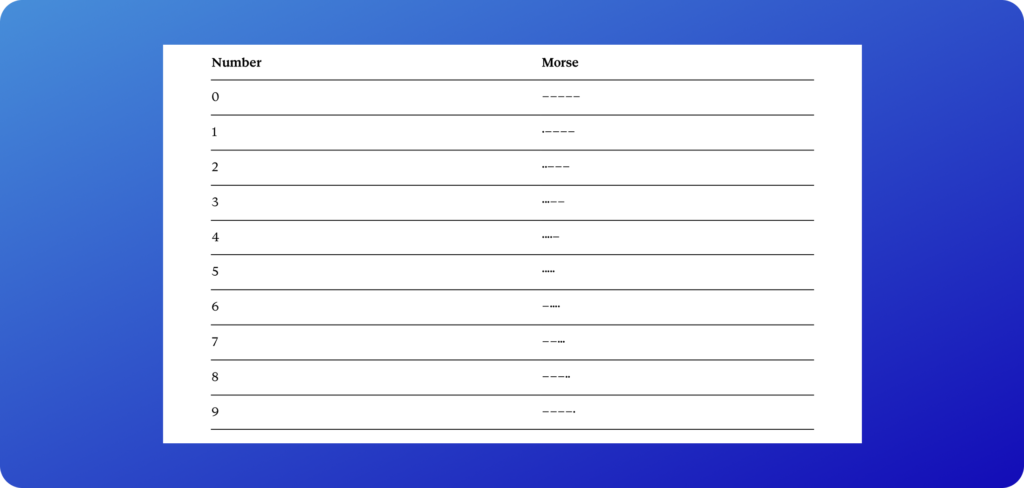
The Morse code numbers 0–9 form two simple groups:
For example, 3 is …– because it begins with three dots, while 8 is —.. because it contains three leading dashes followed by two dots. Recognizing this structure is easier than memorizing ten unrelated patterns.
The main difference between Morse code numbers and letters is the number of signals in each character:
When a message contains only letters and numbers, a five-signal character indicates a digit. However, punctuation marks and prosigns can also contain five or more signals, so context remains important.
Although counting can help you understand the structure at first, practise hearing each digit as one complete rhythm. This will make numbers in Morse code easier to recognize at higher speeds.
Morse code numbers are the digits 0 through 9 represented by fixed combinations of dots and dashes. Each digit contains exactly five signals and follows the same pattern wherever International Morse Code is used.
Larger values do not receive separate symbols. Instead, they are written one digit at a time. For example, 27 combines 2 ..— and 7 –…, producing:
..— –…
These numeric patterns can represent dates, times, coordinates, frequencies, signal reports, and other information that requires exact values.
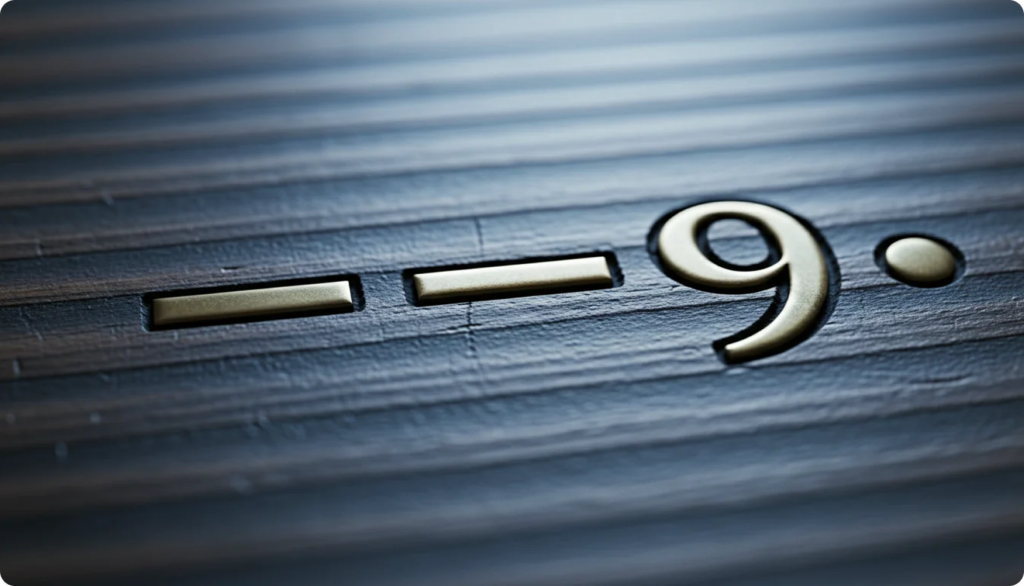
Learning Morse code numbers is easier once you recognize their repeating structure. Every digit from 0 to 9 contains exactly five signals, and the sequence changes gradually from dots to dashes as the numbers increase.
In our guide, you can explore the complete Morse code number chart, learn how each digit sounds, and understand the correct timing between signals. We also explain how to write multi-digit values, including Morse code numbers 1–10 and numbers up to 100.
Whether you want to read dates, times, coordinates, or radio reports, these patterns will help you identify and send numbers in Morse code clearly and accurately.