
Once a few common words click as whole rhythms in your head, the rest of Morse opens up fast. Stop drilling the alphabet in isolation and start practicing the words you’d actually want to send. That’s how every fluent operator got there.
No. Ordinary words do not have individual Morse symbols. Each word is formed by converting its letters into dots and dashes and placing the correct gap between them.
The single-letter word “I” is one of the easiest because it is written as ... For a short multi-letter example, try NO -. — or OK — -.-.
Words are separated by a silent gap equal to seven time units. In written Morse, this space between words in Morse code is commonly represented by a slash /.
Convert each letter separately, place one written space between the letter patterns, and use a slash between complete words. For example, CAT is written as -.-. .- –.
PLEASE is written as .–. .-.. . .- … .. Each group represents one letter, so the spaces between the groups must remain clear.
SOS does not officially stand for “Save Our Ship” or “Save Our Souls.” It is a continuous distress prosign written as …—… and sent without gaps between S, O, and S.
A word is spelled using separate Morse letter patterns. In contrast, a prosign combines characters into one uninterrupted signal that communicates an instruction, such as AR for “end of message.”
Q-codes are standardized three-letter abbreviations transmitted through Morse code. For example, QTH asks for a location, while QSL confirms that a message was received.
The number 73 means “best regards” in amateur radio communication. It is sent as two separate digits: –… …–.
Yes. You can combine letters, words, numbers, and supported punctuation to form complete sentences. Maintain a 3-unit gap between letters and a 7-unit gap between words so the message remains readable.
Yes, but standard International Morse Code does not assign separate patterns to Urdu-script characters. To create Morse code for Urdu words, first write the word in Roman Urdu and then convert each Latin letter into Morse code.
For example, سلام can be written as SALAM:
… .- .-.. .- —
The final result may vary because one Urdu word can have different Roman Urdu spellings. Therefore, choose a clear spelling before converting it.
Find concise answers to common questions about writing, spacing, and understanding Morse code words.

Begin with familiar words such as HELLO, YES, NO, PLEASE, THANKS, and GOODBYE. Because you already know their meaning, you can focus completely on rhythm and spacing.

Practise words such as WHO, WHAT, WHERE, WHEN, READY, AGAIN, and OK. These words help you build short conversational exchanges instead of memorizing unrelated patterns.

LOVE, FRIEND, HOME, MISS YOU, and I LOVE YOU are popular choices for notes, gifts, and words for Morse code bracelets. Always verify every letter before engraving or printing a permanent design.

HELP, STOP, FIRE, WATER, DOCTOR, and INJURED are useful practice terms. However, remember that SOS is a continuous distress prosign, not an ordinary word written with spaces.

Radio learners can practise words such as CALL, SIGNAL, RADIO, WEATHER, ANTENNA, and RECEIVED. These terms prepare beginners for longer CW exchanges without replacing formal Q-codes.

Once complete words feel comfortable, introduce short forms such as TNX, QTH, QSL, AR, and SK. These patterns help you understand how experienced operators shorten common Morse code phrases.
Different word groups develop different communication skills. Therefore, practise a balanced selection of everyday expressions, personal messages, operator vocabulary, and short phrases.
Once you can recognize individual letters, stop practising them only in isolation. Complete words help you understand natural rhythm, spacing, and repeated letter combinations. Use the following approach to improve your recognition:
Short daily sessions are more effective than occasional long practice. Aim for accuracy first, then increase speed without sacrificing letter and word spacing.
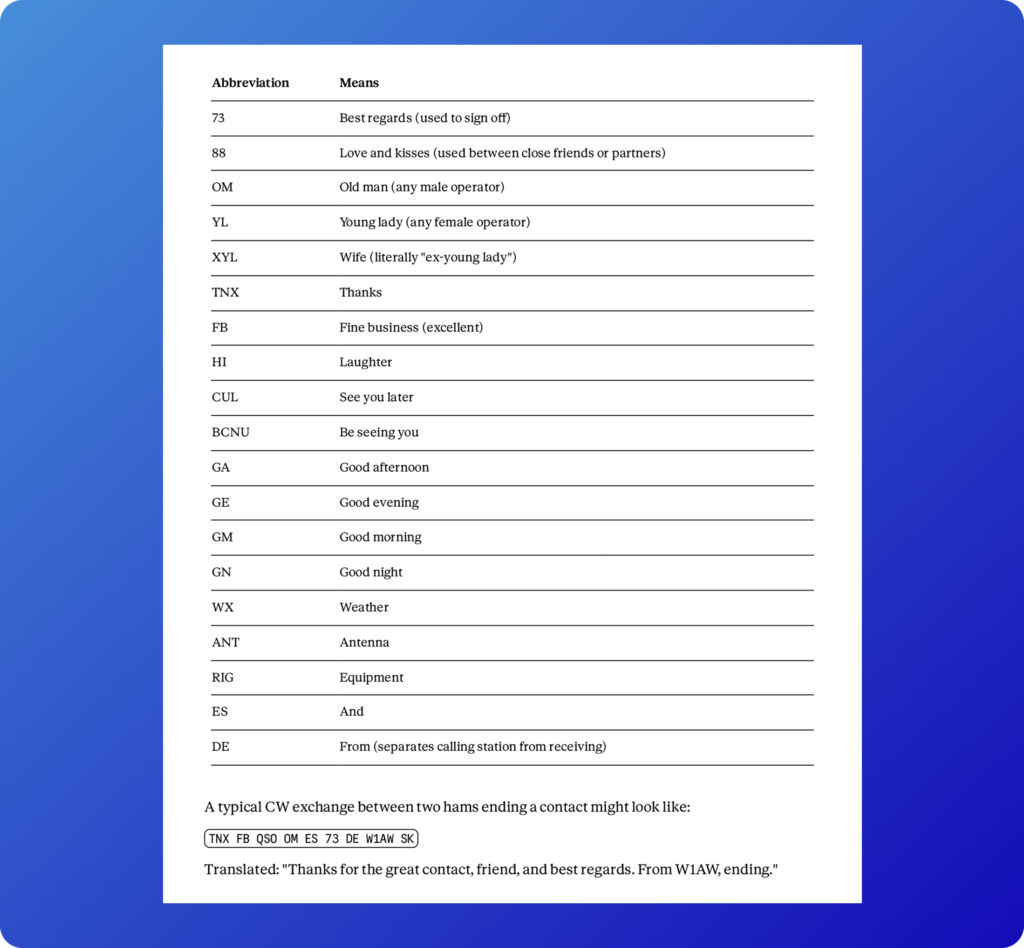
For example, an operator may send:
TNX FB QSO OM ES 73 DE W1AW SK
This means: “Thanks for the excellent contact, friend, and best regards. From W1AW, ending contact.”
These shortened forms make common Morse code words faster to transmit. However, beginners should learn the full words first and introduce abbreviations gradually as their listening skills improve.
Radio operators often shorten familiar words in Morse code to save time and reduce unnecessary signals. These CW abbreviations are not separate Morse symbols. Each abbreviation is transmitted using its regular letter patterns.
The following Morse code abbreviations commonly appear in amateur radio conversations:
Q-codes are standardized three-letter abbreviations originally created to make radio communication faster and clearer. Instead of sending a complete sentence, operators can use one short code that is understood across different languages.
A Q-code usually becomes a question when followed by a question mark. Without the question mark, the same code can provide information or an instruction.
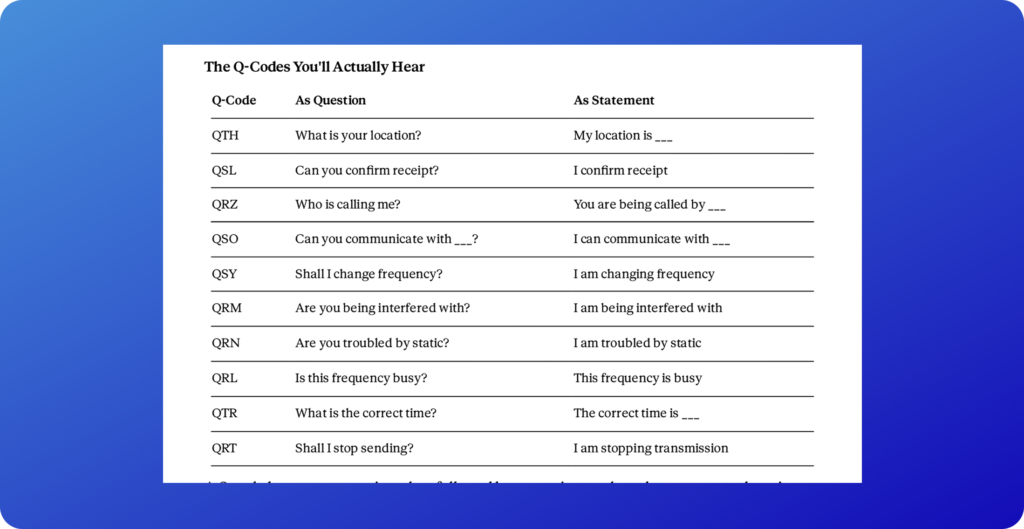
For example, QTH? asks for a station’s location, while QTH introduces the sender’s own location. These compact Morse code abbreviations allow operators to communicate complete ideas using only three characters.
Although Q-codes are not ordinary Morse code words, they remain an important part of CW communication and practical operator vocabulary.
Prosigns are joined character patterns that communicate instructions instead of spelling regular words. Operators use them to start, organize, and end transmissions efficiently.
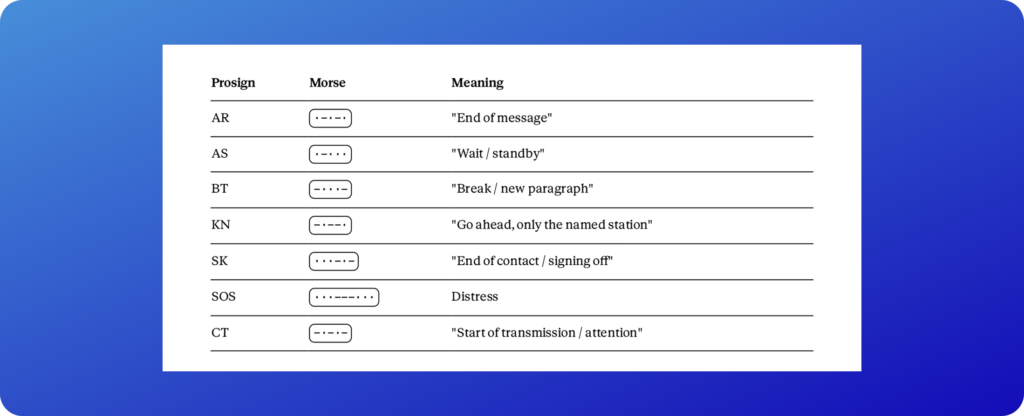
Each prosign is sent as one uninterrupted pattern. For example, AR combines A and R without the normal gap between letters. Similarly, SK indicates that the complete contact is ending, while BT separates sections within a longer message.
SOS in Morse code is written as …—…. Although people often read it as three letters, operators transmit the pattern as one continuous signal without letter gaps.
SOS does not officially stand for “Save Our Ship” or “Save Our Souls.” These phrases were added later as memory aids. The pattern was selected because its three dots, three dashes, and three dots are simple to send and easy to recognize.
Therefore, SOS is better understood as a distress prosign rather than an ordinary Morse code word.
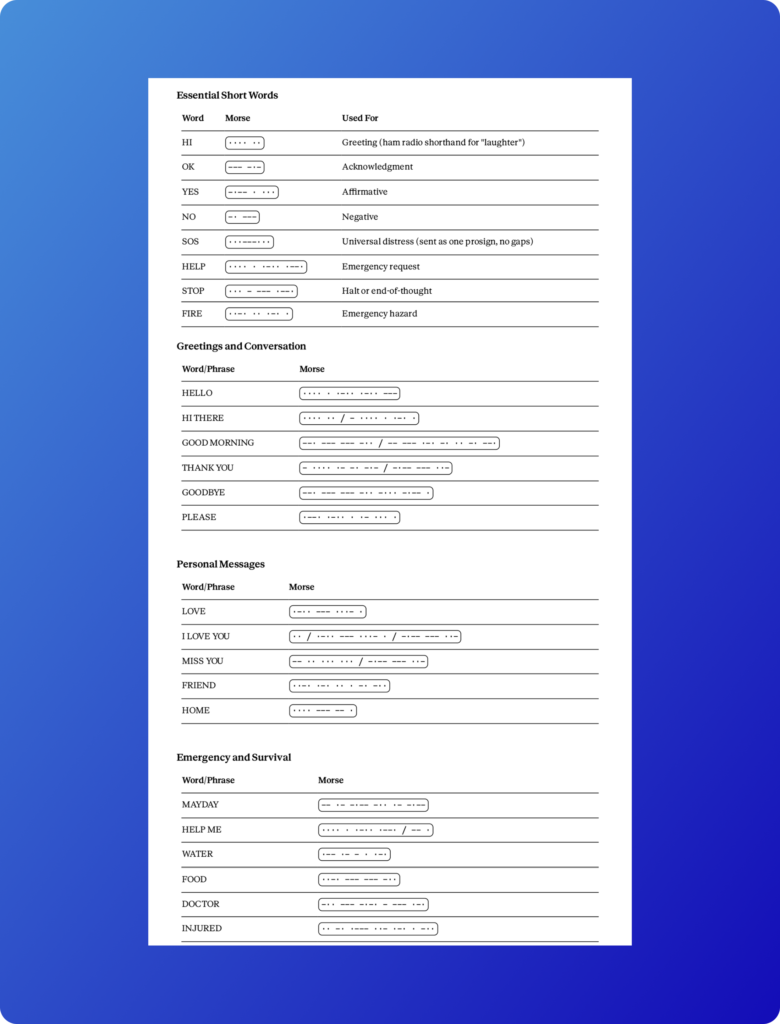
Start with short, familiar words that are easy to recognize and useful in real conversations. The following Morse code word examples include greetings, responses, polite expressions, and simple instructions. First, send each word slowly and maintain clear spaces between its letters. Next, listen to the complete pattern without looking at the table. Finally, combine familiar words such as “HELLO,” “ARE,” and “YOU” to create short Morse code phrases.
Correct timing separates a clear message from a confusing sequence of signals. When learning how to write a word in Morse code, follow these five timing rules:
Dit = A dot lasts 1 unit.
Dah = A dash lasts 3 units
Gap between dits and dahs inside a letter = Dots and dashes within one letter have a 1-unit gap
Gap between letters in a word =Letters within one word have a 3-unit gap
Gap between words = Separate words have a 7-unit gap
In written Morse, a slash / commonly represents the space between words in Morse code. However, the slash itself is not transmitted as part of the message. In sound or light communication, it becomes a longer silent pause.
Worked example: “I LOVE YOU”
Sent together: ( .. / .-.. — …- . / -.–
Notice that single spaces separate letters, while slashes separate complete words. Once you understand this structure, you can build longer Morse code phrases without running the characters together.
Morse code words are formed by converting each letter into its corresponding pattern of dots and dashes. There is no separate code for an entire ordinary word. Instead, individual letter patterns are joined using standard timing and spacing.
Within one letter, dots and dashes are separated by a 1-unit gap. Complete letters have a 3-unit gap, while separate words have a 7-unit gap. Therefore, correct spacing is essential because it tells the listener where each character and word ends.
For example, the word HELP in Morse code is written letter by letter:
HELP : (… . .-.. .–.)
When learning how to form words in Morse code, practise the complete rhythm instead of stopping to count every symbol. With regular listening, familiar words gradually begin to sound like connected patterns rather than separate letters.
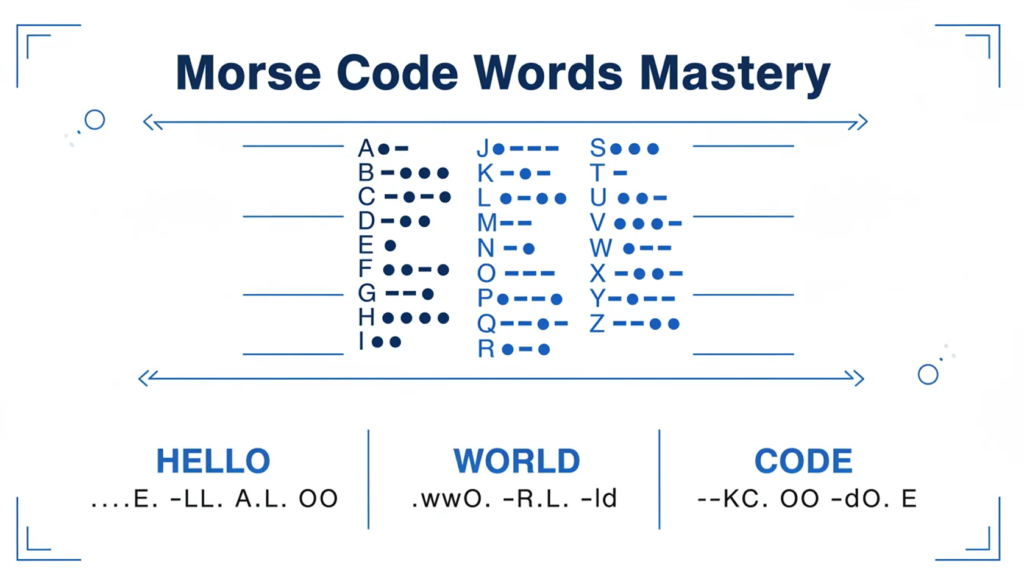
Once you recognize individual letters, the next step is combining them into complete Morse code words. Ordinary words do not have separate Morse symbols. Instead, each word is formed letter by letter, with precise spaces showing where one character ends and another begins.
In this guide, we explain how to form words in Morse code, use the correct spacing, and practise familiar examples such as HELLO, WORLD, PLEASE, and HELP. In addition, you will learn common phrases, abbreviations, and prosigns used by radio operators to communicate more efficiently.
Whether you are practising listening, preparing a bracelet message, or writing your first coded sentence, our examples will help you understand the rhythm of complete words instead of reading isolated dots and dashes.