

Suppose you discover an old railroad telegram with three dashes (—). Curious about its meaning, you enter the pattern into an online Morse code translator. The outcome is the letter O, but the initial railroad diagram indicates the same pattern as number 5. Believe it or not, both of these translations can be right!
This confusion is due to the two codes of Morse: American Morse code and International Morse code. While they both transmit information in the form of dots and dashes, there are some variations for letters, numbers, and timing patterns. An interval in any movie of a history signal can alter its meaning.
To comprehend these differences, it is important to know the difference between International and American Morse code. This guide contrasts their alphabets, their signal timing, the origins of their history, and decoding examples of practical use to show you which is correct to use before interpreting a message.
International vs. American Morse Code: What’s the Difference?
The first point of difference has to do with the character patterns, the second one with the timing of the signals, and the third one with the rules of spacing in International and American Morse. Both systems are represented by dots and dashes, but both signals may mean the same letter or number using the different code.
American Morse code was invented for the early electric telegraph networks and was widely adopted in North American railroad telegraph operations. International Morse code, on the other hand, became a standardized code adopted for Morse code teaching and current radio communications.
The two alphabets have 15 letter patterns that are the same, and 11 letters and 9 numbers that are not. Specific long dashes and pauses with some characters are also part of the older American system.
Key Differences at a Glance
| Feature | American Morse Code | International Morse Code |
|---|---|---|
| Primary Use | Historical landline and railroad telegraphy | Modern radio communication |
| Letter Patterns | 11 letters differ | 11 letters differ |
| Number Patterns | 9 digits differ | 9 digits differ |
| Dash Length | Ordinary and extended dashes | Standardized dash duration |
| Character Spacing | Special internal pauses in some letters | Consistent spacing rules |
| Modern Relevance | Historical preservation and demonstrations | Amateur radio and educational tools |
The variations are important for understanding past telegrams or for interpreting other unrecognized or uncommon signals. Knowing how each system evolved is the basis for comprehending why the systems are different.
Why Are There Two Versions of Morse Code?
Because of the differences in telegraph communication in Europe and America, two versions of Morse code developed. Character systems were required that were appropriate to the equipment, languages, and communication needs of operators as electrical telegraph networks grew in the nineteenth century.
How Morse and Vail Developed the Original Telegraph Code
Morse and Alfred Vail experimented with an electrical telegraph, which could convey messages by wires, during the 1830s. They translated letters into short and long electrical signals and had early receiving machines that recorded them on paper tape.
Morse showed the ability to use the technology on May 24, 1844, when he transmitted the message “What hath God wrought” from Washington, D.C. to Baltimore, where Vail received it.
This was a landmark step in the development of the American telegraph system. The spread of communication networks made it vital to railroad companies to use the technology to transmit in-service communications between far-flung stations. With time, telegraph operators also developed the ability to hear the clicks from receiving instruments.
How Friedrich Gerke’s Revisions Led to International Morse Code
By the late 1840s, Europeans had finally come to believe that they wanted a standardized way to communicate across national lines.
In 1848, the original code was changed by the German telegraph specialist Friedrich Clemens Gerke, with a number of irregular timing conventions being abandoned and the codes for characters being shortened.
In 1851, it was adopted by the larger world thanks to the German-Austrian Telegraph Union. On the heels of those improvements, the code was further refined and came to be known as International Morse code after a series of international telegraph agreements in 1865.
Meanwhile, older American telephone models were sticking around for decades.
When looking at old messages, this historical separation provides some cues. In the 1870s, railroad records in the U. S. might be in American Morse, and a continental form on telegraph records may prevail. Before reading what the signal says, however, the date, location, and original code chart for the document must always be read.
How Do Morse Code Signals and Timing Rules Differ?
The dots and dashes of two Morse signals may have the same form, but they may represent different characters due to variations in the duration of signals and their gaps. The European Morse code has official timing; American Morse code is based on hearing practice on landlines.
Timing differences are particularly relevant when analysing old telegrams or looking at old code charts.
Dots, Dashes, and Extended Signals
Each Morse Character is started by a short and long electrical signal. Both of these ways of measuring the relative length are performed, however.
The length of a dash is three times the length of a dot in International Morse. American Morse has historically employed some dash lengths, such as ‘extended signals’ for each letter.
One of the Morse timing models used in the United States describes:
- Dot: One time unit.
- Common dash: Two units.
- Long dash: Four units, letters L.
- Extra-long dash: Five units of length 0.
These values provide a useful learning reference, although historical operators did not follow one universally fixed timing standard. Actual durations varied between operators and telegraph networks.
Internal Character Spaces in Railroad Morse
The distinguishing characteristic of many of Railroad Morse code’s symbols is the meaningful pause within some of the characters.
Review the letters I and O in AMERICAN MORSE.
Both have two dots, but they are placed at different times:
- I: two circles with a normal short space between them (..).
- O: two dots with a longer internal pause (. .).
In these patterns, the space within O is part of the pattern. Now picture two short, beeping sounds and nothing that came after. Given the time between those clicks, an expert click-clacker might be able to read different letters without having to jot them down.
This distinction also accounts for the fact that one message could have a different meaning, the language of the transcription being removed by the central symbols from an old message compared to an original message.
International Morse and the 1-3-7 Timing Rule
International Morse avoids these special internal character pauses by following consistent timing relationships.
The 1-3-7 rule defines how signals and spaces should be transmitted:
- 1 unit: One dot or the gap between elements within a character.
- 3 units: One dash or the gap between separate letters.
- 7 units: The gap between words.
For example, when a dot lasts 0.1 seconds, a dash lasts 0.3 seconds, and the silence separating words lasts 0.7 seconds.
These proportions remain the same when the transmission speed changes.
Why does this matter? Imagine receiving a continuous Morse message without visible spaces between its letters. The duration of each silent interval helps determine where one character ends and the next begins.
Consequently, accurate decoding depends on recognizing both the electrical signals and the silence separating them. This becomes particularly important when moving between historical American telegraph recordings and modern International Morse.
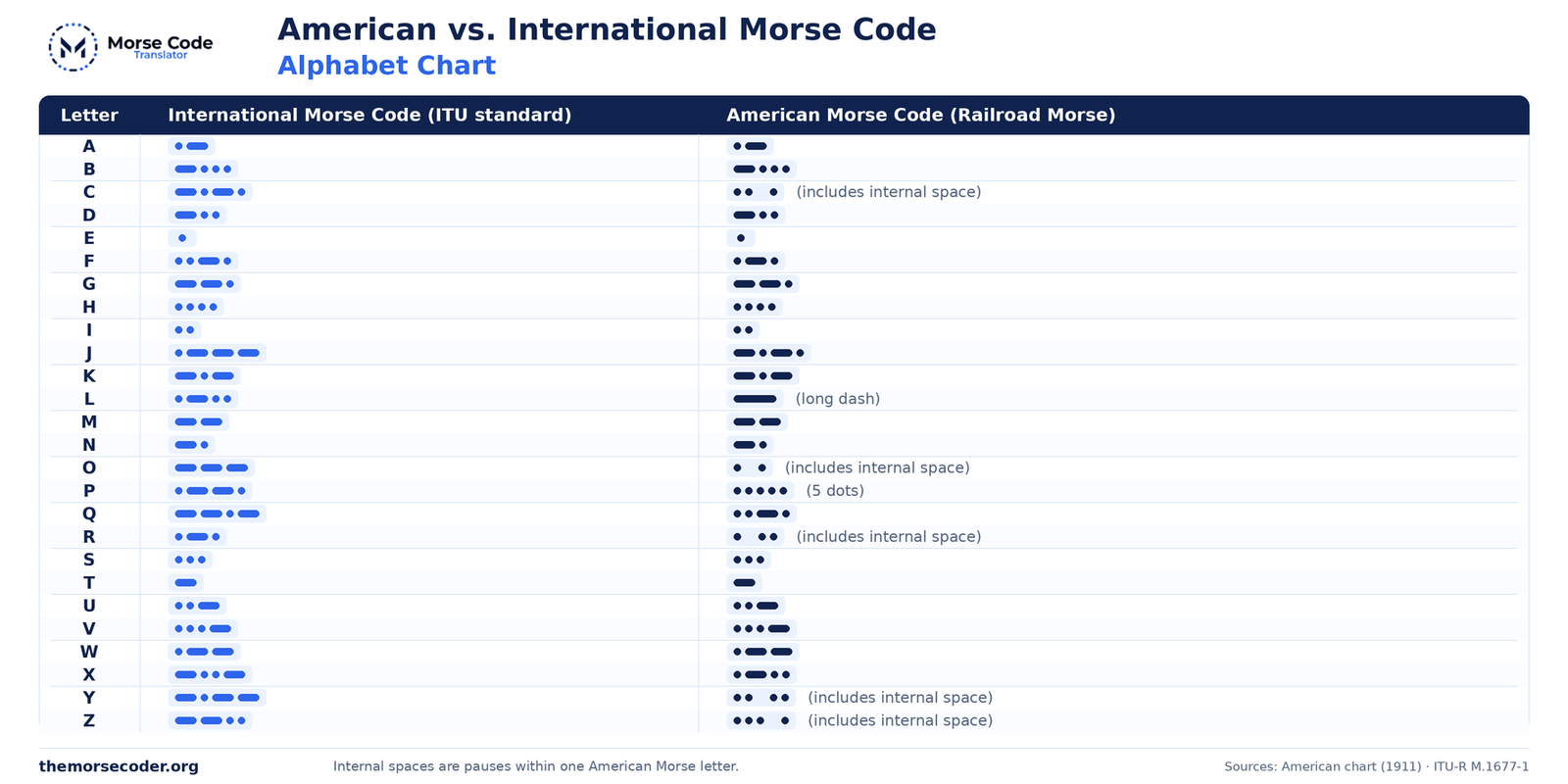
When you learn to identify the letters that retain the same patterns (such as “A” for “A” and “i” for “i” in American Morse code), or use a variant pattern indication for the same letter in Morse code 2 (International), reading will be simpler. There are 26 English letters, only 15 of which have the same dot-and-dash sequences, and the remaining 11 have different sequences.
The best is to start with the familiar letters and to look at the characters that signify the appearance of new signals or unfamiliar meanings.
Which 15 Letters Stay the Same in Both Morse Alphabets?
Both systems share the written patterns for A, B, D, E, G, H, I, K, M, N, S, T, U, V, and W. Those with experience in American Morse, however, have noted that their actual rhythms when communicating on this new transmitter may vary due to the fact that American Morse uses different timing conventions.
For instance, the letter “H” is made from 4 successive points (….) in both letter sets. In the same manner, N has -, because it stands for two tens and 50 more, and S has 3 dots, which denotes five hundreds.
Attempt to say the word SEND. In both systems, its letters are represented as dots and dashes:
… | . | -. | -..
There is one vertical line between the letters on each line. The separators are provided for purposes of simplicity in the written example and should not be interpreted as important.
As each individual letter is a part of the shared group, its written pattern doesn’t change. Listening to the word sent by an American telegraph sounder, however, may still be something different than hearing it today through a modern Morse tone.
How to Recognize the 11 Letters That Change
The remaining letters, C, F, J, L, O, P, Q, R, X, Y, and Z, need closer attention. Their differences fall into three recognizable groups.
Letters with meaningful internal pauses
There are a number of characters that are different on American Morse—specially spaced characters in C, O, R, Y, and Z.
For example, the International Morse is -.-. and the American Morse is .. …. There are two downward dots, a pause dot in the middle, and a final dot in the pattern in the American texture.
Like American O, International Morse does not use three dashes (—) but . . instead. The letters R, Y, and Z have related spaced patterns: .., .. ., and … ., respectively. Their International equivalents are .-., -.–, –… Read historical code, keeping these internal pauses. Otherwise, there might seem to be two or more distinct letters in a single character.
Letters with reassigned signal patterns
Five additional letters do have a different combination of dots and dashes. The result from American F (R internationally) is R. The equivalent of American J is .-.-., the European pattern for C.
The rest of the changes are in the same vein. American P uses ….., Q uses ..-., and X uses .-… Their International equivalents are .–., –.-, and -..-.
Sometimes, one of these patterns can give confusing results; indeed, a decoder could pop up a recognisable character without displaying an error.
The letter with a special long dash
American L is different from the other changed letters.
Unlike International Morse’s .-.., the American system will use an extended dash to represent L (out-of-bounds, represented by ⸺, below).
For a longer signal, the length of the signal is important and needs to be recognized, particularly in a recorded signal as opposed to code.
How to Decode the Same Word Using Both Alphabets
There is a helpful example to consider, that of RAIL, as the American system historically was known as ‘railroad telegraphy ‘.
The word in International Morse is:
.-. | .- | .. | .-..
Now read the same word using American Morse:
. .. | .- | .. | ⸺
Notice how A and I retain their familiar patterns, while R changes to a spaced-dot character and L becomes one extended dash.
Begin by picking out each letter one at a time. Next, see how its signal is formed and if it is the American or International alphabet. Lastly, connect the known letters to make the whole word!
This little exercise shows that there’s a crucial shortcoming in examples of written Morse. Letters get read by the vertical separators, but in actual transmissions, timing must communicate them.
If you’re seeing one of these symbols in an old historical message where you don’t know the spacing or signal length, keeping them all together will greatly improve your odds of figuring out what the message means.
As these alphabet differences become predictable, next it’s useful to be able to compare numerical patterns, particularly as most of the digits also remain the same in the two systems.
American vs. International Morse Code Alphabet Chart
Once you’ve determined how the alphabets represent individual letters, it will be easier to learn the American and International Morse code alphabets. In both alphabets, there are the same 26 letters of English but they are not necessarily identical in terms of their visual representation.
There are 15 letters that have the same dot-and-dash code; for the other 11, there are different interpretations. This sequential tutorial explains how to tell the difference and how to read words without getting the two systems confused.
Step 1: Identify Which Morse Alphabet You Are Reading
Before you attempt to translate any message, determine if the source of the message is using AMERICAN Morse or INTERNATIONAL Morse.
Rely on identifying familiar symbols, like C or O or L. These letters will contain useful clues, as they are represented differently.
For example:
- International C: -.-.
- American C: .. .
- International O: —
- American O: . .
Notice the spaces within the American patterns. These represent meaningful pauses that belong to the characters themselves.
If you’re examining a historical railroad document, its original code chart may offer further clues. However, the source alone cannot confirm which alphabet was used.
Step 2: Recognize the 15 Letters Shared by Both Systems
Once you understand which alphabet you’re examining, begin with the letters that have matching patterns.
The shared letters are A, B, D, E, G, H, I, K, M, N, S, T, U, V, and W.
For instance, the letter S uses three dots (…) in both systems, while N uses a dash followed by a dot (-.).
Try decoding the word SEND:
… | . | -. | -..
Read each group from left to right:
- … represents S.
- . represents E.
- -. represents N.
- -.. represents D.
The result is SEND in either alphabet.
Because all four letters belong to the shared group, their written sequences remain unchanged. Nevertheless, actual signal durations can differ between the systems.
Step 3: Learn the Five American Letters with Internal Spaces
Next, focus on C, O, R, Y, and Z. These letters contain distinctive internal pauses in American Morse.
Their patterns are:
- C: .. . (two dots, pause, one dot)
- O: . . (one dot, pause, one dot)
- R: . .. (one dot, pause, two dots)
- Y: .. .. (two dots, pause, two dots)
- Z: … . (three dots, pause, one dot)
Consider the American letters I and O.
The letter I contains two closely spaced dots (..), while O contains two dots separated by a longer pause (. .).
Without that distinction, both characters would look identical in a simplified transcription.
When practicing, preserve the internal spaces and listen to each character as one complete rhythm. This helps prevent the common mistake of treating a single American letter as two separate characters.
Step 4: Identify Letters That Change Meaning Between Alphabets
Some American patterns are identical to entirely different International Morse characters.
For example, .-. represents F in American Morse, but R in International Morse.
Similarly:
- -.-. represents American J and International C.
- ….. represents American P and International 5.
- ..-. represents American Q and International F.
- .-.. represents American X and International L.
These similarities are particularly important when using a Morse code translator.
Imagine receiving -.-. from an older telegraph source. Entering it into an International Morse translator produces C, even though the original sender may have intended J.
To avoid this error, select the appropriate alphabet before assigning meanings to the patterns.
Step 5: Recognize the Special Long Dash for American L
The letter L presents a different challenge.
International Morse represents L as .-.., containing one dot, one dash, and two additional dots.
However, American Morse uses a single extended dash, commonly represented as ⸺.
To identify this character in an original transmission, pay attention to the duration of the signal rather than simply counting its elements.
This distinction becomes especially useful when examining telegraph sounder recordings, where the duration of an extended mark helps distinguish it from an ordinary dash.
Step 6: Practice Decoding a Complete Word in Both Systems
Now apply the previous steps to the word RAIL.
First, examine its International Morse representation:
.-. | .- | .. | .-..
The patterns decode as:
- .-. = R
- .- = A
- .. = I
- .-.. = L
Next, examine the American Morse representation:
. .. | .- | .. | ⸺
This time:
- . .. = R, with an internal pause.
- .- = A, unchanged.
- .. = I, unchanged.
- ⸺ = L, using an extended dash.
Both versions spell RAIL, but the first and last letters use different signals.
For additional practice, try the word FIRE. Compare the patterns for F and R before checking the unchanged letters I and E. This exercise helps develop the habit of identifying individual character rhythms rather than assuming the two alphabets are interchangeable.
Once you can distinguish these letter patterns confidently, the next challenge is recognizing numbers and punctuation, where several equally important differences appear.
Leave a Reply