
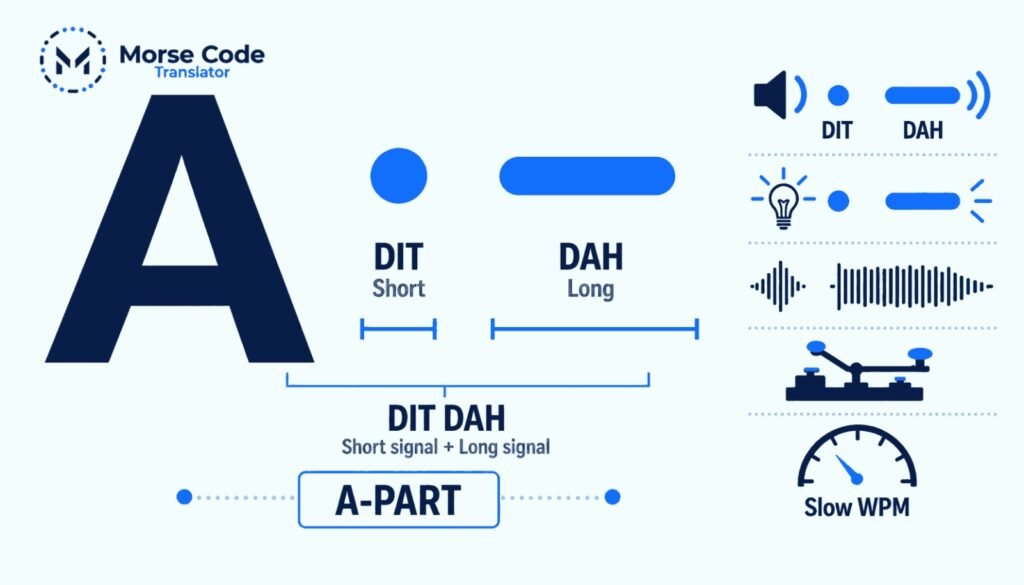
A in Morse code is written as .- (·−), which consists of one dot followed by one dash. A dot is a short signal and a dash a long one. They are combined to make the letter A in International Morse code.
Say “A” in Morse code as “dit-dah. Always begin with a “dit,” then a longer “dah”. The same rhythm is used for the communication of the same letter, by means of sound, light, or some other signaling technique.
The vowel “A” is represented by the pattern .- There is no hidden meaning for this in the context of the item. It is part of words and complete messages when joined to other letters, however.
You can write A in Morse code by typing a dot followed by a dash: .-. You must not separate the two symbols with a space or other character, since they form the representation of one character.
A uses dot-dash (.-), while N uses dash-dot (-.). Both have 2 signals, but the signals in the two signals are swapped. Hence, they sound and act differently and are different letters.
The pattern for No. (.-) shall be used for both uppercase A and lowercase a. International Morse does not have a different character for the various capital and lowercase letters, so characters do not have to be changed.
Yes. If you are using a flashlight to send A, light it for the dot, then for the pause, turn it off—then back on for three seconds for the dash. This produces the same function of short-long, which is used in audio Morse code.
The simplest is to relate A to the rhythm “dit-dah. Repeat the word sound a couple of times, while gazing at .-. Now attempt to remember the pattern, without gazing at it. This assists in putting words with sounds.
Yes. Type A in the Morse Code Translator, then tap to read it back (short dash, then long dash), and hear it play back.
Find clear answers to common questions about reading, writing, and learning Morse code numbers.
Numbers sometimes need punctuation to express decimals, times, dates, ranges, or divided values. In these cases, send the punctuation mark as a separate character between the relevant digits.
Do not confuse the transmitted slash -..-. with the visual slash used to represent a space between words in written Morse examples. One is an actual punctuation character, while the other is only a formatting aid.
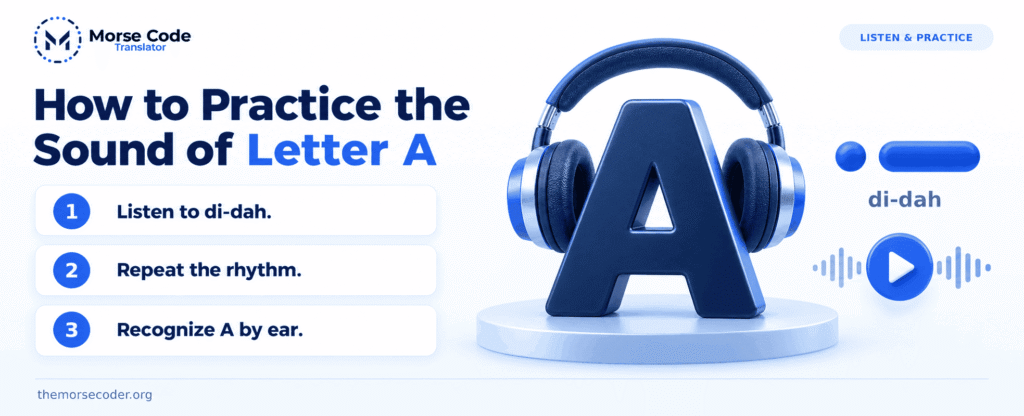
If you have never heard the sound of A in Morse code, picture 2 beeps: the first beep is brief and the second beep is a bit longer. They make a rhythm called ‘dit-dah’.
If the beep is short, it is referred to as a “dit”, and if it is longer, it is called a “ dah”. They can sound exactly the same – they can be the same pitch – but are different because of their different duration.
For understanding the timing, the sequence of workings of each signal is shown:

As you can see, the dah lasts three times as long as the dit. Between them is also a small delay, to prevent mixing the two signals.
But do not need to take it “second- by-second” listening. But rather than that, just try to recall how the 2 sound sequences are linked together: short, then long.
Learning to write the Morse A probably seems difficult, but it is quite simple: just one dot and one dash. When installing, it is important that they all go in the right order to ensure that the pattern is correct.
It’s as simple as the following 3 steps:
After following these directions, your completed pattern will look like this:
A → ·−
Alternatively, if using a keyboard, type a period and then a hyphen:
.-
Both of these versions are of the same character, and thus use either for ease of typing or for ease of reading.
Example: Writing A in a Word
With the knowledge of how to write the letter in isolation, how will it look when it’s part of a word?
If you wish to send the message CAT in Morse code, Don’t translate the entire word; just consider each letter individually.
| Letter | Morse Code |
|---|---|
| C | −·−· |
| A | ·− |
| T | − |
After identifying each pattern, put them together with a space between the letters:
CAT = -.-. .- –
Be sure that A is still “old-fashioned” regardless of the situation. Spaces are just used to delineate each letter from one another.
Once you have seen one example, begin an additional one of your own! You can also check your answer using our Morse Code Translator.
International Morse Code represents each letter by a different combination of dots and dashes: A is a dot (·) and a dash (−).
A = ·−
The dot equals a short signal; the dash is three times the short signal length. They are preceded by a short pause, which helps the listener hear two signals as a single letter.
However, what you do is change the order, and now what?
For example:
The two letters are identical in symbols, but the symbols are in the order of the two letters are reversed. That’s why note the order of the code read or sent while using Morse code. Whenever a change is made, it can turn one letter into another.
Have you ever seen a dot and a dash and wondered what letter it is? Or perhaps you’ve just heard a brief beep and a longer beep and just couldn’t seem to get the meaning of the sounds.
Even two simple signals can be confusing when you’re new to Morse code. Some of the dots and dashes you may recognize, but you may not recognize the sequence or the sounds.
In Morse code, ‘A’ is coded as (·−). It starts with a ‘dit’ and a ‘dah’. They are sounded together to produce the sound ‘dit-dah ‘.
Let’s learn how to write the letter A, how to know the Morse alphabet, and how not to confuse it with similar patterns in the Morse alphabet.